Hieroglyphics Language
| |
Egyptology Articles
Herbs and Aroma
Alternative
Medicine
Aroma Therapy
|
|
There
is about 700 letters in the ancient Egyptian writing system. The ancient
Egyptians considered this type of writing as sacred and religious writings
and most were placed and carved on tombs or wall of temples. The Egyptian
writings were considered the "words of the Gods". The
ibis-headed god Thoth was considered to be the patron deity of writing and
scribes.
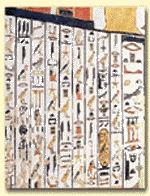
Hieroglyphs
developed from pictorial representations of flora, fauna, buildings,
people and objects of daily use that were familiar to the people. This is
a picture of hieroglyphics on a wall of a tomb.
Hieroglyphs
were primarily used for religious and formal secular purposes. Early in the
historical period, a simpler cursive script was developed, in which each
character was a simplified version of a hieroglyph. This script is today known
as hieratic and was widely used until about 800 BCE for business, literary and
religious texts. By about 700 BCE another script today called demotic had
evolved from the hieratic. Business, legal and literary inscriptions were
written in demotic.
|
 |
Hieratic
Hieratic is an adaptation of the hieroglyphic
script, the signs being simplified to make their writing quicker. Hieratic was
the administrative and business script throughout most of its history, and
recorded documents of a literary, scientific and religious nature. It was most
often used on papyrus rolls or sheets, or on bits of pottery or stone.
Hieroglyphs
were written with a reed brush and ink on papyrus, leather or wood, and on those
surfaces it was harder to attain the crisp quality and detail of the signs as
carved on stone. So cursive hieroglyphic was merely a simpler form of each
hieroglyphic sign. A hieratic sign was not always as clear a counterpart to its
hieroglyphic sign as was cursive hieroglyphic.
Hieratic
should not be confused with cursive hieroglyphic script, though the two resemble
each other. Cursive hieroglyphic script is usually written from right to left in
columns, though just as with hieroglyphic it could vary, and is found almost
exclusively in religious texts such as the Book of the Dead. Hieratic could be
written in columns or horizontal lines, but it always read from right to left.
It also sometimes contained punctuation in the form of a small dot to separate
units of thought.
Demotic
The word "Demotic" comes once again
from Greek, meaning "popular script." By the Hellenistic period of the
Ptolemies, demotic was the only native script in general daily use. It is a very
cursive script, having been derived directly from hieratic, making it difficult
to read and almost impossible to transcribe into any hieroglyphic counterpart.
Demotic
texts were generally administrative, legal and commercial, though there are a
few literary compositions as well as scientific and religious texts. The Rosetta
Stone contains a section inscribed in demotic along with hieroglyphic and Greek.
|
You may freely reprint this article
or place it on your website by
adding this statement: Courtesy of www.kingtutshop.com
|
_________________________________