Home | More Articles | Papyrus | Cartouche | Herbs | Ladies Accessories | Home Decor | Mother of Pearl | Rugs | Others


|


Google
 
Web kingtutshop.com

Eye of Horus

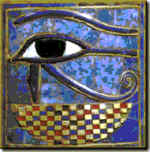
  Horus, represented as the falcon-headed god, was an important god in Egyptian legend. The symbol representing his eye, Eye of Horus, was a powerful symbol used to protect from evil. Pronounced "udjat" by the Egyptians, the Eye of Horus represents a human eye with the cheek markings of a falcon.The ancient Egyptian Eye of Horus or wedjat ('Whole One') is a powerful symbol of protection, and is also considered to confer wisdom, health and prosperity.The ancient Egyptians considered the eye of horus as a representative of eternal renewal of the kingdom from Pharaoh to pharaoh. 

The ancient Egyptians believed that this symbol has a very powerful and magical effect on restoring harmony to the unstabilized world and restoring unrightful things.

According to the old myth, the rivalling god Seth tore Horus' eye out. Seth was his uncle, who contended with him for the Egyptian throne after he had killed and dismembered his father, Osiris. Thot, the wise moon god and the patron of the sciences and the art of writing, put it patiently back in order and healed it. As an ambiguous symbol, it describes the status of regained soundness.

In the field of astronomy it is the moon symbol absolute and refers to the increasing completion of the moon disk; the Eye of Horus symbol was inspired by the "Eye of God" and "solar falcon" that are manifested during total solar eclipses;

 In the most different sizes and degrees of preciousness of its materials, it served as an amulet worn around the neck or as a graphic motif for beautiful jewels; it decorated the lunettes of coffins and sarcophagi; it was part of a suspicious picture mysteries in the ornament of receptacles or other personal objects.  
Egyptology Articles

Herbs Articles

Eye of Horus

Eye of Horus

.


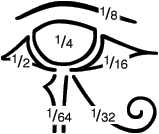
The Eye of Horus symbol was used in funerary rites and decoration, as instructed in the Egyptian Book of the Dead. After 1200 BC, it was also used by the Egyptians to represent fractions, based on repeated division by two. The value of a fraction was assigned to each individual part of the eye which Seth had torn up according to the myth. Their total, corresponding to the restoration of the eye brought about by Thot, should have added up to a whole. In fact, however, the total of the six fractions used results in only 63/64; it was assumed that Thot had withheld the missing 1/64 by magic. The Eye of Horus fraction system was based on the Eye of Horus symbol. This system was used to record prescriptions, land and grain.

Fractions are created by combining sections of the Eye of Horus symbol. Each section has a different value. The complete Eye of Horus with all parts in place has a value of 1. In reality the complete Eye of Horus represents 63/64, which is rounded off to 1.

The system is based on halves. Half of 1 equals 1/2, half of 1/2 equals 1/4 and so on until the smallest value of 1/64. By adding together the values of different sections fractions are created.

The 'Rx' symbol which is used by pharmacies and in medicine has its origins in the Eye of Horus.

Eye of Horus

Separated sections with fraction values


You may freely reprint this article or place it on your website by adding this statement: Courtesy of  www.kingtutshop.com


_________________________________

Ancient Egyptian Civilization and Egyptology Articles


Google

Learn more about Pharaohs era and Ancient Egypt Civilization. 

18th DYNASTY

Abu Simbel Temple

Alexandria

Alphabetic of Hieroglyphics

Ancient Egyptian animals

Ancient Egyptian Boats

Ancient Egyptian Calendar

Ancient Egyptian Clothes

Ancient Egyptian Games

Ancient Egyptian Scribe

Ankhesenamun

Anubis

Boy King

Canopic Jars

Champollion

Chariot

Cleopatra

Egyptian Architect

Egyptian Cartouche

Ancient Egyptian Furniture

Egyptian Sphinx

Eye of Horus

First Intermediate Period

Giza Pyramids

Great Battles

Hatshipsut  

Hieroglyphics Language

Horus

Karnak Temple

King Djoser

King Narmer

Library of Alexandria

Lotus Flower

Marriage in Ancient Egypt

Medicine 1

Medicine 2

Medicine 3

Memphis

Mummification

Music in Ancient Egypt

Nefertity

Papyrus

Periods and Dynasties of Ancient Egypt

Pharos

Ramses II

Rosetta Stone

Second Intermediate

Period

Senet Game

Thebes

Thinite period

Third Intermediate Period

Trading Expeditions

Tuthmosis

Write Your Name In Hieroglyphic

GO To Top


_________________________________

Google


 Herbs and Aroma Articles

Learn more about Herbs in Egypt 

Ajwain Seed

Aloes

Anise

Black Seed

Calendula Flowers

Celery

Chamomile flowers

Cilantro

Coriander

Cornflower

Cumin

Dill

Egyptian Lily

Fennel

Fenugreek

Garlic

Henna

Hibiscus

Marjoram

Onion

Parsley

Peppermint

Sage

Sesame seed

Spearmint

Sunflower Seed

Tamarind

GO To Top

 
Home
Contact us
Rugs Kilim | Tapestries  
Other  Rosetta Stone | Egyptian Thrones

Mother of Pearl Boxes | Paper Clips | Photo Frames | Plates 

Home Decor Hang to wall plates  |  Candle Holder  |  Perfume Warmer
Free  Information    Ancient Egyptian Civilization and Egyptology Articles
Herbs  Buy 100% Natural Egyptian Herbs | Buy 100% Natural Egyptian Essential Oils
Ladies Accessories Egyptian Silver Jewelry  | Bracelets | Necklaces | Earrings | Perfume Bottles | Pharaohs bags
Egyptian Cartouches  Egyptian 18K Gold Cartouches  |  Egyptian Silver Cartouches | Silver with Gold Cartouche
Papyrus  Strips | Papyrus Kit | Writing Kit | Blank Sheets |  Paintings | Wedding Invitations | Logos | Papyrus outlines
Others Retailers | Contact us | Testimonial | What's New | Special Offer | Catalog |  Links | Add Site | affiliate | Site Map
Misc.Pharaohs puzzle | Calendar | Coaster | Book Marks | Mouse Pad | Note Books | Hieroglyphic stickers