Home | More Articles | Papyrus | Cartouche | Herbs | Ladies Accessories | Home Decor | Mother of Pearl | Rugs | Others


|


Google
 
Web kingtutshop.com

Mummification


Mummification is still one of the wonders of the ancient Egyptian civilization that not all of its secrets have been revealed.

 The word ‘mummy’comes from the Arabic word mumiyah, and it means bitumen.

A mummy is a body that has been preserved so that it will last forever. The ancient Egyptians believed that if a person's body was preserved, he or she would continue living in the next world.


The first evidence for mummification procedures as found in the last of the first dynasty pharaohs regime. The legend says that the first Egyptian to be embalmed and reincarnated was Osiris himself.

Until the popularizing of the Osiris cult, mummification was only practiced on kings and those closest to them, but from the Middle Kingdom onwards it was made available to all who could afford it.

    Before mummification the Egyptians buried their dead in simple earthern pits. The dry sandy soil of Egypt had a natural tendency to preserve dead bodies, allowing the fluids to drain away and preventing the corpse from decaying and thus creating lifelike and natural mummies.

Later, the ancient Egyptians began burying their dead in coffins to protect them from wild animals in the desert. However, they realized that bodies placed in coffins decayed when they were not exposed to the hot, dry sand of the desert.

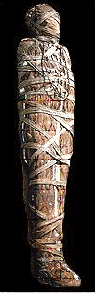
Over many centuries, the ancient Egyptians developed a method of preserving bodies so they would remain lifelike. The process included embalming the bodies and wrapping them in strips of linen. Today we call this process mummification.
Egyptology Articles

Herbs Articles

Mummification

.


When a Pharaoh had died, the Egyptians took him to a beautiful house or a tent known as ‘íbu’ because it kept the air fresher.  They undressed the body and laid it on a wooden table called an embalming table.  The table top was not always solid; sometimes it was just bars of wood so they could get underneath to put the bandages on, but they put them on later.

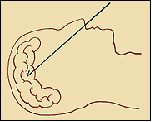
The brain was first removed, it was drawn out through the nose aperture with a hook after being macerated into little pieces.

A flint knife was used to cut open the left side, and the internal organs, stomach, liver, intestines were extracted. It is important to remove these because they are the first part of the body to decompose.

The liver, lungs, stomach and intestines are washed and packed in natron which will dry them out. The heart is not taken out of the body because it is the centre of intelligence and feeling and the man will need it in the afterlife.

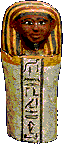
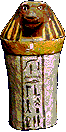
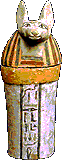
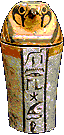
These organs were given separate treatment; embalmed, wrapped and placed in the four so –called ‘Canopic Jars’.

The body is now covered and stuffed with natron which will dry it out. All of the fluids, and rags from the embalming process will be saved and buried along with the body. After forty days the body is washed again with water from the Nile. Then it is covered with oils to help the skin stay elastic. The dehydrated internal organs are wrapped in linen and returned to the body. The body is stuffed with dry materials such as sawdust, leaves and linen so that it looks lifelike.

The wound made by the dissector was covered with a plaque that conferred the protection of the four sons of Horus. The body was then ritually cleaned and purified before the wrapping began.

The whole body would be coated in resin, and cosmetics were sometimes added in order to give the body its final life-like appearance. Whilst the body was then completely bandaged up, amulets would be inserted between the wrappings in the appropriate places as described in the Book of the Dead. Bandaging the body would take around fifteen days.


The entire process, from death to burial would take around seventy days.


The four canopic jars that the internal organs were placed in are also buried with the deceased.

.

.


 Imsety the human-headed god looks after the liver.


 Hapy the baboon-headed god looks after the lungs.


Duamutef the jackal-headed god looks after the stomach.


Qebehsenuef the falcon-headed god looks after the intestines.

Natron is a material produced by combining sodium carbonate and bicarbonate and naturally found in deposits of sesquicarbonate of soda. This was an important element in mummification as a drying and antiseptic agent.

More Info about Canopic Jars

.

.


You may freely reprint this article or place it on your website by adding this statement: Courtesy of  www.kingtutshop.com


_________________________________

Ancient Egyptian Civilization and Egyptology Articles


Google

Learn more about Pharaohs era and Ancient Egypt Civilization. 

18th DYNASTY

Abu Simbel Temple

Alexandria

Alphabetic of Hieroglyphics

Ancient Egyptian animals

Ancient Egyptian Boats

Ancient Egyptian Calendar

Ancient Egyptian Clothes

Ancient Egyptian Games

Ancient Egyptian Scribe

Ankhesenamun

Anubis

Boy King

Canopic Jars

Champollion

Chariot

Cleopatra

Egyptian Architect

Egyptian Cartouche

Ancient Egyptian Furniture

Egyptian Sphinx

Eye of Horus

First Intermediate Period

Giza Pyramids

Great Battles

Hatshipsut  

Hieroglyphics Language

Horus

Karnak Temple

King Djoser

King Narmer

Library of Alexandria

Lotus Flower

Marriage in Ancient Egypt

Medicine 1

Medicine 2

Medicine 3

Memphis

Mummification

Music in Ancient Egypt

Nefertity

Papyrus

Periods and Dynasties of Ancient Egypt

Pharos

Ramses II

Rosetta Stone

Second Intermediate

Period

Senet Game

Thebes

Thinite period

Third Intermediate Period

Trading Expeditions

Tuthmosis

Write Your Name In Hieroglyphic

GO To Top


_________________________________

Google


 Herbs and Aroma Articles

Learn more about Herbs in Egypt 

Ajwain Seed

Aloes

Anise

Black Seed

Calendula Flowers

Celery

Chamomile flowers

Cilantro

Coriander

Cornflower

Cumin

Dill

Egyptian Lily

Fennel

Fenugreek

Garlic

Henna

Hibiscus

Marjoram

Onion

Parsley

Peppermint

Sage

Sesame seed

Spearmint

Sunflower Seed

Tamarind

GO To Top


Home
Contact us
Rugs Kilim | Tapestries  
Other  Rosetta Stone | Egyptian Thrones

Mother of Pearl Boxes | Paper Clips | Photo Frames | Plates 

Home Decor Hang to wall plates  |  Candle Holder  |  Perfume Warmer
Free  Information    Ancient Egyptian Civilization and Egyptology Articles
Herbs  Buy 100% Natural Egyptian Herbs | Buy 100% Natural Egyptian Essential Oils
Ladies Accessories Egyptian Silver Jewelry  | Bracelets | Necklaces | Earrings | Perfume Bottles | Pharaohs bags
Egyptian Cartouches  Egyptian 18K Gold Cartouches  |  Egyptian Silver Cartouches | Silver with Gold Cartouche
Papyrus  Strips | Papyrus Kit | Writing Kit | Blank Sheets |  Paintings | Wedding Invitations | Logos | Papyrus outlines
Others Retailers | Contact us | Testimonial | What's New | Special Offer | Catalog |  Links | Add Site | affiliate | Site Map
Misc.Pharaohs puzzle | Calendar | Coaster | Book Marks | Mouse Pad | Note Books | Hieroglyphic stickers